
Dynamic flow splitter
With a dynamic flow splitter, the Venturi effect is additionally reinforced by a spring-loaded flow body.
As a result, a greater pressure difference Δp can be built up in the distribution pipe even at very low volume flows. This effect means that even low volume flows from approx. 50 l/h in the distribution pipe generate significant induction volume flows.
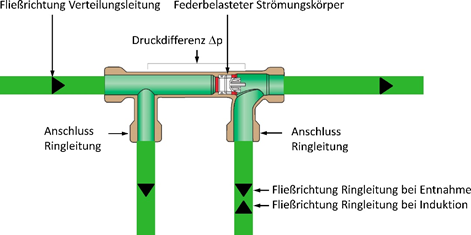
Functional principle of a dynamic flow splitter:
The pressure difference is relatively high at low volume flows in the distribution pipe, but low when peak volume flows occur. At a volume flow of approx. 50 l/h, for example, the pressure difference generated in a dynamic flow splitter with a nominal diameter of DN 25 is approx. 15 hPa, while at a volume flow of approx. 3,000 l/h it is less than 50 hPa. This ensures at all times that the demand coverage of the tapping valves arranged downstream of the flow splitter is not impaired by an excessive pressure drop. In addition, cold drinking water flows through the ring main even at low flow rates.
The flow splitter therefore not only ensures the supply of cold drinking water to the ring main, but also allows cold drinking water to flow in the ring main when water is withdrawn in a wet room connected downstream in the direction of flow. With this installation method, a water change can be realised when a wet room is not in use, without water having to flow unused into the sewage system due to flushing measures.
You can find more information on our YouTube channel.
Click here for the video - KHS flow splitter in a flushed section
Click here for the video - Turbulent flow in the Venturi flow splitter ring main