Bernoulli equation
In the steady flow of an incompressible fluid, the sum of static pressure, dynamic pressure and geodetic pressure is the same at every point of the flowpath. In frictional flows, the pressure loss that occurs between the two points must be added to the point following in the direction of flow.
In a drinking water installation, all flow paths generally start at the valve tapping clamp or behind the water meter of the water supply company and end at a tapping valve.
With the simplifying assumption that the flow velocity along the flow path (in the sections) is approximately the same and using the standardised designations for the static pressures pminWZ and pminFl, the Bernoulli equation for consumer pipes is obtained in the representation known from DIN 1988-300:
pminWZ = pminFl + Δpgeo + Σ(l*R + Z) +ΣΔpAp +ΣΔpRV
For each flow path, the sum of the flow pressure, the geodetic pressure difference and the flow-dependent pressure losses must not exceed the static pressure downstream of the water meter.
Bernoulli's equation is valid for all flow paths between the service pipe and the taps.
For a complete pipe network calculation, a corresponding hydraulic proof must therefore be provided for each of these flow paths to ensure that the sum of the minimum flow pressure, the geodetic pressure difference and the flow-dependent pressure losses does not exceed the static pressure downstream of the water meter.
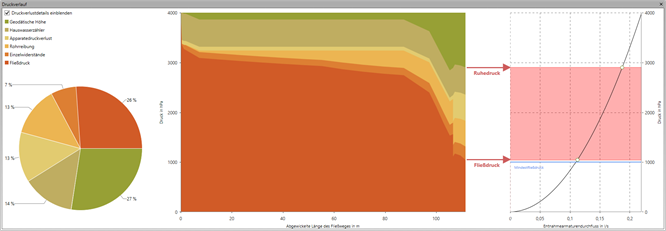
This relationship is shown graphically in the pressure curve diagram.