Differential pressure regulators are independently regulating line regulating valves. They are used to maintain a constant pressure between two points. In a heating system, the pressure of the thermostatic valve at the consumer is thus kept constant, even under partial load. In doing so, the differential pressure regulator independently balances a heating system. The flow rate is defined via the setting values on the differential pressure regulator.
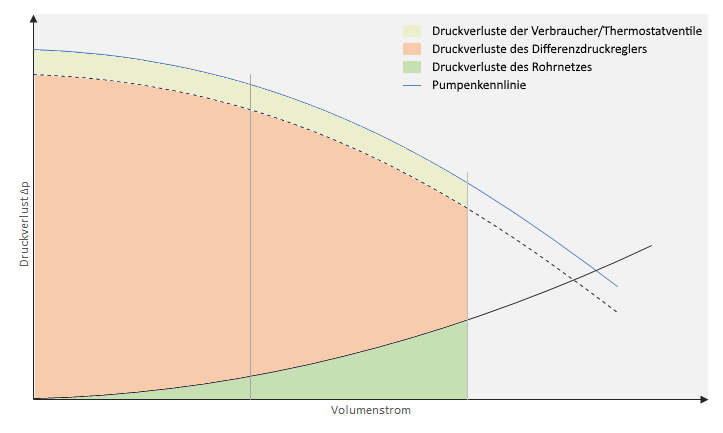
Figure 1. Operating principle of the differential pressure regulator The above diagram clearly shows that the differential pressure regulator ensures that the pressure to be reduced and thus the valve authority remain constant at the thermostatic valves at partial load (centre line) and at full load (right-hand limit edge). The calculated setpoint pressure in the line is maintained regardless of the degree to which the thermostatic valves are open. The differential pressure regulator reduces the pressure that is not required (orange-coloured field).
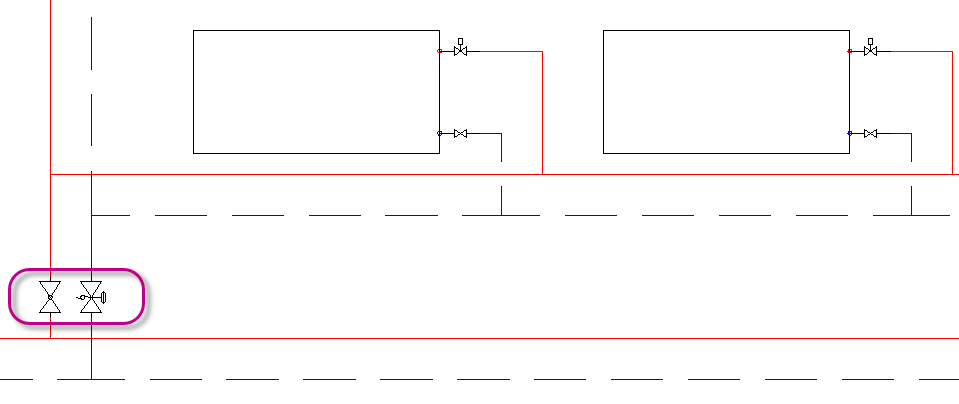
Figure 2. Differential pressure regulator in the pipework
The differential pressure regulator works without auxiliary energy and contains a diaphragm system and a counter spring for adjusting the setpoint. The diaphragm is connected to the pipework fitting in the flow pipe, which measures the pressure in the flow pipe, via a connected pulse line. The valve cone moves depending on the pressure situation. When the differential pressure rises, the valve cone moves in the closing direction. If the pressure falls, the valve cone moves in the opening direction. This means that only the set target pressure is present in the line and pressure fluctuations are regulated via the differential pressure regulator.
You can find more information on our YouTube channel.