
Sampling plan
In accordance with the Drinking Water Ordinance of 2023 and numerous other references in standards and guidelines, the operator is responsible for the system and also for the sampling points . The operator must appoint a qualified person to ensure that suitable sampling points are identified and that a sampling plan is drawn up. It is recommended that this be agreed with the public health authority. The public health authority has the right to designate, add or arrange for new suitable sampling points.
The main reason for taking samples is to be able to draw conclusions about the entire network by sampling at representative points within the drinking water network. Nevertheless, samples are taken from individual sections where critical conditions arise due to prolonged periods of stagnation, temperatures exceeding the limit (> 25°C for cold water) and temperatures falling below the limit (<55°C for hot water), rarely used tap points, as well as rooms where people with weakened immune systems or children/babies are present, samples are taken.
With version 2025, it is now possible to systematically check the installation positions prescribed by the standards.
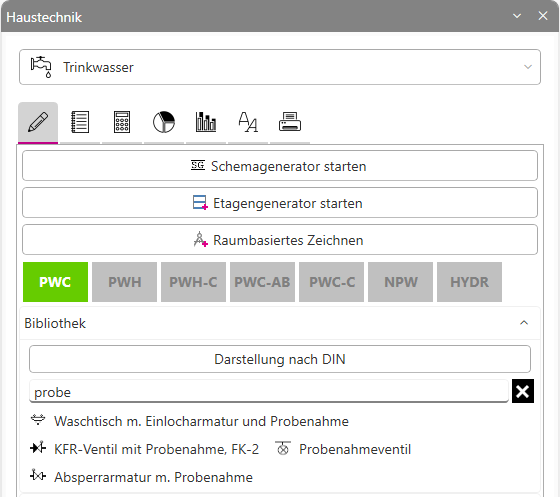
- The component library has been extensively expanded so that sampling valves can be fitted not only to all valves to be combined.
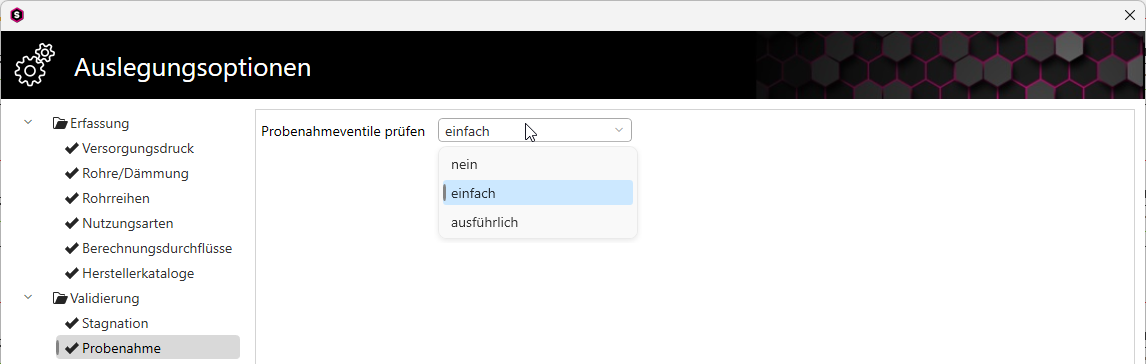
- The options allow you to set the level of detail required for sampling validation.
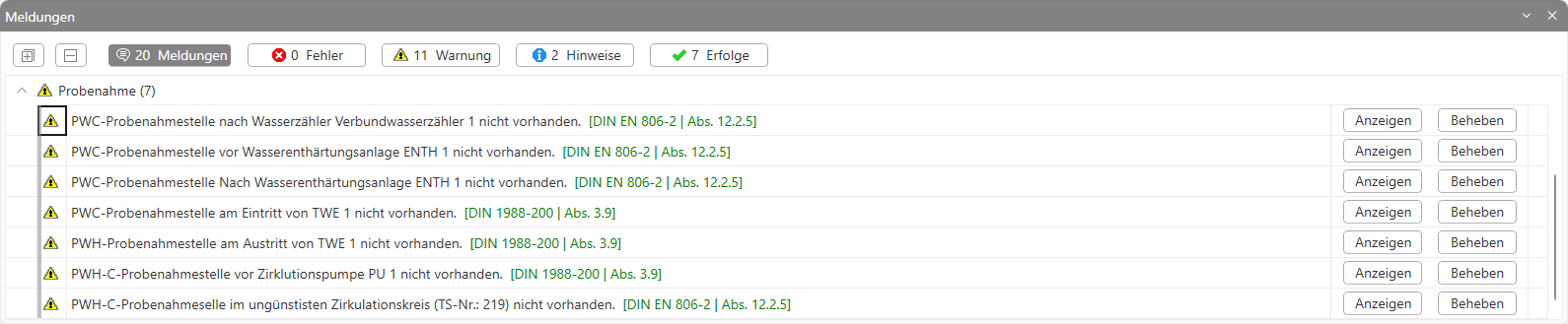
- Following the calculation, you will receive warnings if these installation scenarios cannot be sampled, along with a convenient quick-fix function to resolve the issue.
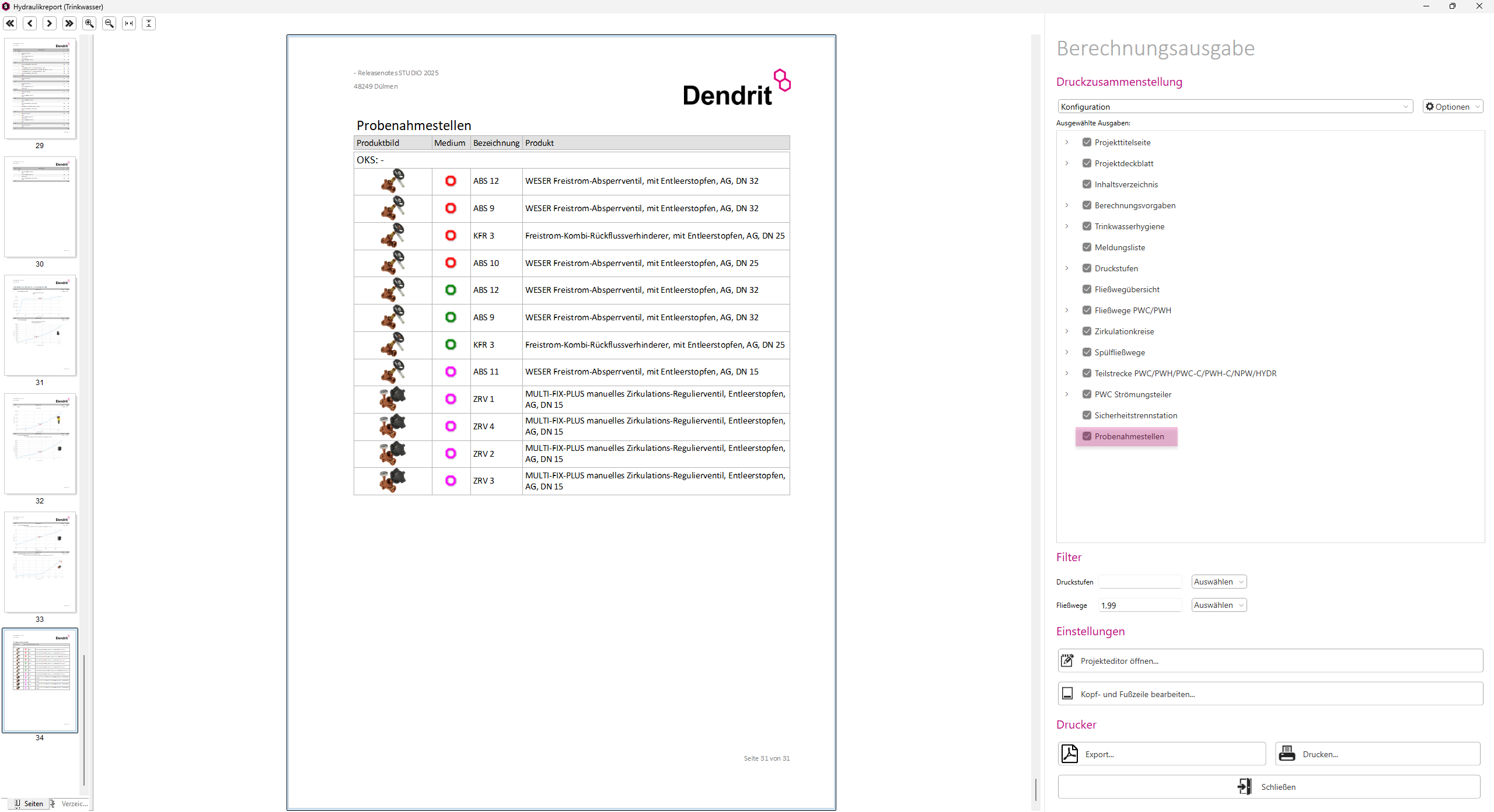
- In the hydraulics report, you will find a new report option, ‘Sampling Points’, which lists all sampling points in the project. In addition to the location and designation of the sampling point, the medium to be sampled is also listed.
- Naturally, all the necessary components and accessories are also listed in the materials list, which ensures a smooth procurement process.