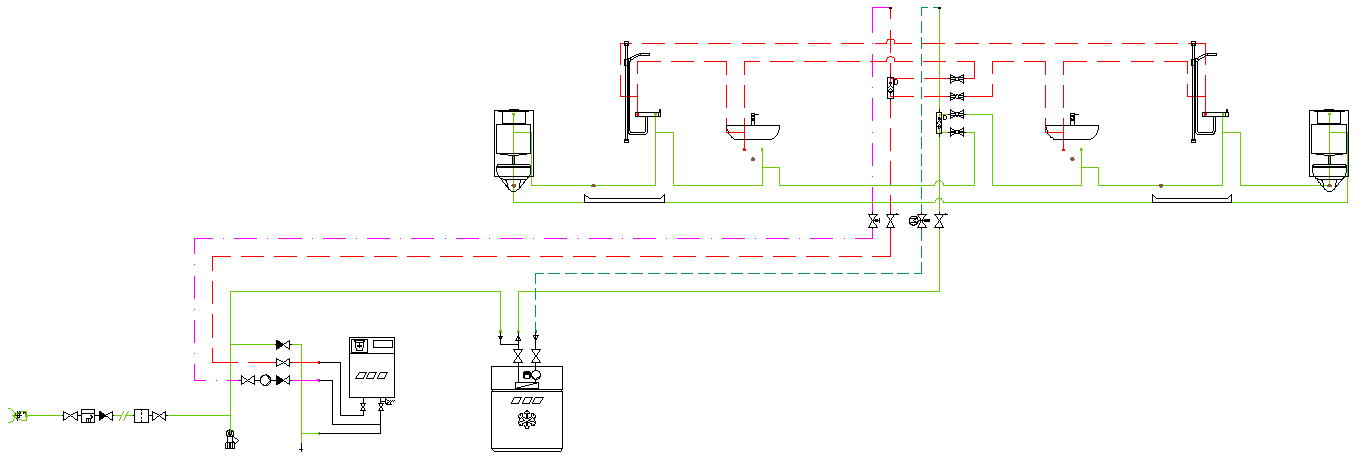
Circulation circuit
Any connection between a hot water circulation pipe (PWH-C) and a hot water supply pipe (PWH), or any connection between a cold water circulation pipe (PWC-C) and a cold water supply pipe (PWC), creates a circulation circuit. To ensure that hot or cold drinking water circulates at optimum energy efficiency, only the flow rate necessary to maintain the temperature must flow through each circulation circuit. For balancing, there must be at least one thermostatic circulation control valve (e.g. a KEMPER MULTI-THERM or a KEMPER ETA-THERM) in each connecting pipe and thus in each circulation circuit or a static circulation control valve (e.g. a KEMPER MULTI-FIX-PLUS) must be installed.
In a circulation system, the flow paths begin at the discharge port of the circulation pump, run from there via a circulation connection to the consumption pipe and then end back at the suction port. The flow paths (flow lines) form closed loops within the circulation pump and are thus referred to as circulation circuits.